
For New Orleans, a 6th Final Four is bounce-back moment
Apr 1, 2022
A seat at the 182-year-old French Quarter restaurant that invented Oysters Rockefeller and mastered Baked Alaska is virtually impossible to get this week
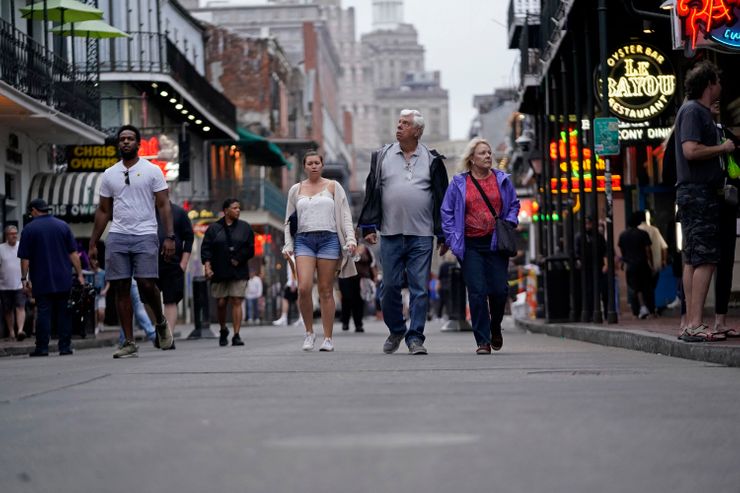
NEW ORLEANS (AP) — A seat at the 182-year-old French Quarter restaurant that invented Oysters Rockefeller and mastered Baked Alaska is virtually impossible to get this week as the first NCAA men's Final Four without pandemic restrictions in three years comes to this historic port city near the mouth of the Mississippi River.
It's a simultaneously joyous and frustrating time for Lisa Blount, whose family operates Antoine's — a restaurant which opened in 1840, only had French menus for most of its existence, and has a long tradition of hosting Mardi Gras “royalty.”
Because of challenges to finding and training staff since the pandemic, bookings have been limited to about half of the upwards of 600 per night there would normally be for an event this big — meaning half as many orders of Pompano Ponchartrain with crab meat or Filet Marchand de Vin.
“It's great to see people in town and this type of event that is so high-profile, but it’s frustrating because we still have issues with staffing,” Blount said. “I feel so bad. People are calling everywhere and can’t get a reservation for dinner.”
The country — and much of the world — is trying to put the fears and frustrations of COVID-19 in the rear mirror.
Few things in the sports world resemble a return to pre-pandemic life like a Final Four in a sold-out Superdome and all that goes with it.
This weekend, fans are flocking to New Orleans in no small part because of the teams involved. Duke, Kansas, North Carolina and Villanova all have storied basketball histories and huge fan followings. On top of that, Duke coach Mike Krzyzewski, among the most successful coaches of in the history of the sport, is retiring after this season, giving Saturday night's semifinals — and perhaps Monday night's final — added historical significance.
“There’s interest for people who aren’t necessarily Duke fans that want to come see this," said Jay Cicero, president of the Greater New Orleans Sports Foundation, which along with Tulane and the University of New Orleans makes up the Final Four host committee. “It’s a historic moment, it really is, and adds to the list of historic moments for New Orleans and the men’s Final Four.”
Past Final Fours in New Orleans have featured Michael Jordan's emergence with North Carolina in 1982; Keith Smart’s heroics for Bobby Knight-coached Indiana in 1987; Chris Webber’s infamous timeout call (when Michigan had none left) against North Carolina in 1993; Carmelo Anthony’s offensive dominance for Syracuse in 2003; and Anthony Davis’ unparalleled defensive display in 2012.
Now comes another highly anticipated edition of college basketball's marquee weekend in a city that is not only synonymous with Final Four memories of the last four decades, but whose economy is largely driven by a tourism industry devastated by the COVID-19 pandemic — starting with the cancellation of the 2020 NCAA Women's Final Four and the world-renowned Jazz and Heritage Festival after that.
Cicero said until recently, there remained considerable uncertainty surrounding local planning for this Final Four, particularly during the surge of the Omicron variant of the coronavirus between Thanksgiving and New Year's. Officials came up with a wristband system aimed at easing access for vaccinated fans to events. But that was happily scrapped and virtually all restrictions lifted after the Mardi Gras parade season passed in late February without a subsequent COVID surge in March.
That development was quite the departure from March of 2020, when "the disappointment, the shock, and unpredictability of the near future at that time had us all in a state of bewilderment,” Cicero said. “We hoped but couldn’t have anticipated that COVID numbers would have reduced dramatically enough to host the Final Four without any restrictions."
In New Orleans, the tourism business was virtually non-existent in the spring of 2020 and ended the year down 80% from 2019, said Walt Leger, executive vice president and incoming CEO of New Orleans and Co., the city's non-profit tourism agency. In 2021, tourism business was still down 60% from before the pandemic, Leger said.
“This is a premier opportunity — one of the most important and well-known sporting events — for us to get back into the swing of things,” Leger said. “It’s hard to even measure how important that is."
Related events will include a Fan Fest at the city's convention center, and free concerts at a riverside park.
The events are walkable from New Orleans' more than 22,000 downtown hotel rooms — for those who could get one. Officials say bookings were so strong that many visitors have been referred to hotels and short-term rentals across the metro area.
New Orleans is hoping for similar turnouts for the first Jazz Fest in more than two years later this spring, followed by the return of major convention business.
If so, the next challenge will be filling jobs.
Tourism employment dropped from 95,000 jobs down to 45,000 in 2020 and has risen back to about 65,000, Leger said.
Hence the relative difficulty getting tables at the city's many renowned restaurants.
But Leger sees a silver lining in that visitors will be motivated to venture out to more neighborhood joints locals love, but which tend to get less tourist traffic.
Chef Susan Spicer — who launched popular French Quarter restaurant Bayona and helped fellow James Beard Award-winning Chef Donald Link open Herbsaint downtown — now spends most of her time at a low-key restaurant called Rosedale. It's hidden on a bumpy side street in the Lakeview neighborhood, named for its proximity to Lake Pontchartrain.
Spicer said she'll be working double shifts this weekend at Rosedale, where favorites include cochon de lait po'boys and duck pastrami sandwiches, as well as barbecue shrimp and sauteed gulf fish.
Spicer said a lot of area chefs are hustling “on the line” in the kitchen, more so than they would in pre-pandemic times, because of the relative lack of staffing, combined with upticks in business. But they're not complaining.
“We need the business so it’s still exciting,” Spicer said. “We want to feed people. We like hearing the restaurants be loud.”
And Spicer appreciates the synergy of sports and the hospitality industry from her many years participating in the Taste of the NFL events held during Super Bowl weekends.
“Those sports guys love to come and spend money; they’re pretty high rollers," Spicer said. "They’ll drop some much-needed cash in the city and that’s awesome. It doesn’t really matter where it goes.”
___
More AP college basketball: https://apnews.com/hub/college-basketball and https://apnews.com/hub/ap-top-25-college-basketball-poll and https://twitter.com/AP_Top25
More News

Want to bag a break but save some cash? Here's our pick of the best travel deals available this week - from savings on all-inclusive Egypt stays to affordable city breaks
The Daily Mail's travel desk brings you a selection of the best deals currently available - so you can bag a bargain break.

Illegal mining threatens French Guiana forests and indigenous communities
In French Guiana, the fight against illegal gold mining is rapidly being lost and creating an environmental and health disaster, according to the World Wildlife Fund. During an aerial survey in early August, park rangers counted 239 illegal sites within the protected area in record.

15 Products Self-Described Overpackers Swear By
Love you, but HOW do you not own a pack of compression bags yet...? View Entire Post ›

"In Spain, It Was Everywhere": 40 Things That Exist Outside The US That Prove America Is Embarrassingly Behind The Rest Of The World
"They put ours to shame." View Entire Post ›

Plan A Trip Around The World, And I'll Tell You Which American City You Should Visit
As Mr. Worldwide once said: "Brazil, Morocco, London to Ibiza. Straight to LA, New York, Vegas to Africa" View Entire Post ›

27 Products That’ll Make Holiday Travels So Much Smoother
Because there are one too many holiday movies that start with the main character missing a flight, and that does NOT need to be your journey this season. View Entire Post ›

The science of Cantonese soups and the gut health benefits – just don’t boil too long
In the first instalment of a four-part Health Matters series on food and health, Lisa Cam unpacks the enduring ritual of Cantonese soup, revealing what modern science says about family recipes, seasonal ingredients and the modern workarounds keeping this domestic staple on the table. In many Chinese households, soups are seen as a show of love from the cook – usually the matriarch of the family. Soup can be everyday food or a banquet course made with ingredients according to the season. The...

Has treatment for stuttering been off base? New guidelines go beyond speech to the brain
More than 80 million people worldwide stutter, yet misconceptions on it persist in the medical field, and access to appropriate care can be limited. New international medical guidelines aim to change that.

Canada is spending more than ever on health care. Are we getting our money's worth?
Canada is spending more on health care than ever. Whether Canadians are getting more care for their money is another question. A new report from the Canadian Institute for Health Information (CIHI) projects health-care spending will reach a record $433 billion in 2026, or $10,398 per person, an increase of 4.8 per cent over last year.

Why Some Flights Were Exempt From the Ground Stop
Dozens of international flights departed from the United States during Friday’s nationwide ground stop. Some planes also left for Hawaii from the West Coast.

Brooke Shields’ jeans? Met Gala’s ‘extraOrdinary’ show celebrates everyday fashion
And now, Take 2: the new Met Gala exhibition will celebrate everyday garments and materials such as jeans and puffer jackets, paper and plastic – and how fashion designers transform them. The new theme sounds about as far as can be imagined from the glittering, elaborate designs of John Galliano, the British designer who was originally the subject of the Met’s fashion exhibition next spring – before that idea was scuttled amid an outcry over his past antisemitic statements. The replacement show...

Le Plaza set to shake up Geneva’s cultural scene with new hotel concept and reimagined cinema
Following the opening of Brasserie Europe at Le Plaza in June, the cultural destination is now gearing up to open Cinéma-Hôtel Le Plaza on 04 December 2026, marking a major milestone for the project. This will then be followed by the opening of the reimagined historic Plaza Centre Cinéma on 22 April 2027, completing the transformation of this iconic architectural landmark.