
In locked down Chinese city, some complain food hard to get
Jan 4, 2022
Residents of the Chinese city of Xi’an are enduring a strict coronavirus lockdown, with business owners suffering yet more closures and some people complaining of difficulties finding food
BEIJING (AP) — Residents of the Chinese city of Xi'an are enduring a strict coronavirus lockdown, with business owners suffering yet more closures and some people complaining of difficulties finding food, despite assurances from authorities that they are able to provide necessities for the 13 million people largely confined to their homes.
Stringent measures to stem outbreaks are common in China, which still maintains a policy of stamping out every COVID-19 case long after many other countries have opted to try to live with the virus. But the lockdown imposed Dec. 23 in Xi'an is one of the harshest in the country since a shutdown in 2020 in and around Wuhan, after the coronavirus was first detected there.
On Tuesday, authorities announced that another city, Yuzhou in Henan province, was placed under lockdown over the weekend after the discovery of just three asymptomatic cases.
The Chinese have largely complied with the tough measures throughout the pandemic, but complaints have cropped up over tough policies, despite the risk of retaliation from Communist authorities. The Xi'an lockdown, however, comes at a particularly sensitive time, as China prepares to hold the Beijing Winter Olympics, which open Feb. 4, and therefore is under especially intense pressure to contain this outbreak.
“Can’t leave the building, and it’s getting more and more difficult to buy food online,” said one resident of Xi’an, who posted on the social media platform Weibo under the name Mu Qingyuani Sayno. The post was from a verified account, but the person did not respond to a request for further comment.
Zhang Canyou, an expert with the State Council’s epidemic prevention and control team, conceded that “there may be supply pressure in communities.”
But he was quoted by the official Xinhua news agency as also saying: "The government will go all-out to coordinate resources to provide people with daily necessities and medical services.”
The lockdown in Xi'an originally allowed people to leave the house every two days to shop for basic goods, but it has since been tightened, though the rules vary according to the severity of the outbreak in each district. Some people are not allowed to go out at all and must have goods delivered to them. People can only leave the city with special permission.
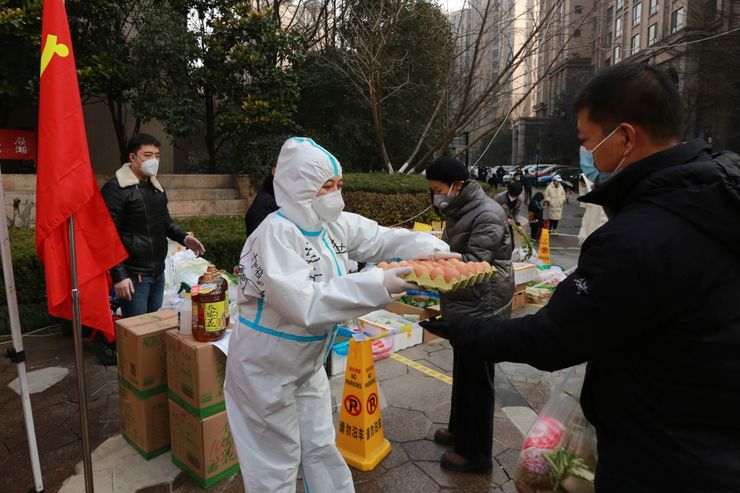
In recent days, people in Xi'an could be seen shopping at pop-up markets, served by workers in head-to-toe white protective suits. Community volunteers also visited people's homes to ask what they needed.
Yet the strain is beginning to show, with residents increasingly complaining on Weibo of being unable to source necessities. In one widely shared video, guards could be seen attacking a man who had tried to deliver steamed buns to family members. The guards later apologized to the man and were each fined 200 yuan ($31), according to a Xi'an police statement posted on Weibo.
In an online diary on the popular Weixin site, a Xi’an-based writer said that following an initial wave of panic-buying and the closure of markets, residents soon began searching for food online.
"In this age of material surplus, when everyone is trying to lose weight, finding enough to eat has suddenly become a difficult task,” Jiang Xue wrote. A message sent to the account was not immediately returned.
China's “zero tolerance” strategy of quarantining every case, mass testing and trying to block new infections from abroad helped it to contain previous outbreaks. But the lockdowns are far more stringent than anything seen in the West, and they have exacted a tremendous toll on the economy and the lives of millions of people.
The measures often fall into place after just a few cases are identified, as was seen in Yuzhou. Since the rules were imposed there on Sunday, residents have been allowed to return to the city of 1.7 million but are not permitted to leave and must isolate at home. Only emergency vehicles are allowed on city roads. Restaurants, sports facilities, and a wide range of other businesses have been ordered to shut, while markets can only offer basic necessities, an order from the city government said.
Meanwhile, Xi’an, home to the famed Terracotta Army statues along with major industries, has seen more than 1,600 cases in a surge that officials say is driven by the delta variant, which is less infectious than the newer omicron strain, of which China has reported only a handful of cases. Another 95 infections were announced Tuesday.
China has reported a total of 102,841 cases and 4,636 deaths since the pandemic began. While those numbers are relatively small compared to the U.S. and other countries, and likely undercounts as they are everywhere, they do show the persistence of the virus despite the sometimes draconian measures taken by China.
A third round of mass testing has been ordered for Xi'an, which is capable of swabbing 10 million people in just seven hours and processing up to 3 million results in just 12 hours, according to state media.
While Wuhan's health care system was overwhelmed after the pandemic began there in late 2019, China has not reported any shortages of beds or medical equipment and staff in Xi'an. Two dozen special teams have been formed to deal with COVID-19 cases and a pair of hospitals have been set aside to provide other types of care, Xinhua reported.
China has vaccinated nearly 85% of its population, according to Our World in Data. The shots have helped reduce the severity of disease, although Chinese vaccines are considered less effective than used those elsewhere.
In a sign of the pressure authorities are under to curb this outbreak, officials have been put on notice that they will lose their jobs if they don't bring the numbers of new cases down. Already, the top two Communist Party officials in Yanta district, where half the city's cases have been recorded, have been fired, according to a statement from the government of the surrounding province of Shaanxi.
The head of a tourism firm reached by phone said Tuesday that supplies were basically sufficient, but that his business had been suffering since July.
“Now with the lockdown, the effect has been extremely big," said the man, who gave just his surname, Wen, as is common among Chinese.
Qin Huilin, who works at a traditional mutton soup restaurant, said the lockdown brought business to a screeching halt.
“We used to have about a hundred customers every day, but we’ve had none for more than a dozen days since the lockdown," Qin said by phone. “The impact on our business is significant, but I can go shopping once every few days in supermarkets and there are enough supplies there."
___
Follow AP’s pandemic coverage at https://apnews.com/hub/coronavirus-pandemic
More News

Want to bag a break but save some cash? Here's our pick of the best travel deals available this week - from savings on all-inclusive Egypt stays to affordable city breaks
The Daily Mail's travel desk brings you a selection of the best deals currently available - so you can bag a bargain break.

Illegal mining threatens French Guiana forests and indigenous communities
In French Guiana, the fight against illegal gold mining is rapidly being lost and creating an environmental and health disaster, according to the World Wildlife Fund. During an aerial survey in early August, park rangers counted 239 illegal sites within the protected area in record.

15 Products Self-Described Overpackers Swear By
Love you, but HOW do you not own a pack of compression bags yet...? View Entire Post ›

"In Spain, It Was Everywhere": 40 Things That Exist Outside The US That Prove America Is Embarrassingly Behind The Rest Of The World
"They put ours to shame." View Entire Post ›

Plan A Trip Around The World, And I'll Tell You Which American City You Should Visit
As Mr. Worldwide once said: "Brazil, Morocco, London to Ibiza. Straight to LA, New York, Vegas to Africa" View Entire Post ›

27 Products That’ll Make Holiday Travels So Much Smoother
Because there are one too many holiday movies that start with the main character missing a flight, and that does NOT need to be your journey this season. View Entire Post ›

The science of Cantonese soups and the gut health benefits – just don’t boil too long
In the first instalment of a four-part Health Matters series on food and health, Lisa Cam unpacks the enduring ritual of Cantonese soup, revealing what modern science says about family recipes, seasonal ingredients and the modern workarounds keeping this domestic staple on the table. In many Chinese households, soups are seen as a show of love from the cook – usually the matriarch of the family. Soup can be everyday food or a banquet course made with ingredients according to the season. The...

Has treatment for stuttering been off base? New guidelines go beyond speech to the brain
More than 80 million people worldwide stutter, yet misconceptions on it persist in the medical field, and access to appropriate care can be limited. New international medical guidelines aim to change that.

Canada is spending more than ever on health care. Are we getting our money's worth?
Canada is spending more on health care than ever. Whether Canadians are getting more care for their money is another question. A new report from the Canadian Institute for Health Information (CIHI) projects health-care spending will reach a record $433 billion in 2026, or $10,398 per person, an increase of 4.8 per cent over last year.

Why Some Flights Were Exempt From the Ground Stop
Dozens of international flights departed from the United States during Friday’s nationwide ground stop. Some planes also left for Hawaii from the West Coast.

Brooke Shields’ jeans? Met Gala’s ‘extraOrdinary’ show celebrates everyday fashion
And now, Take 2: the new Met Gala exhibition will celebrate everyday garments and materials such as jeans and puffer jackets, paper and plastic – and how fashion designers transform them. The new theme sounds about as far as can be imagined from the glittering, elaborate designs of John Galliano, the British designer who was originally the subject of the Met’s fashion exhibition next spring – before that idea was scuttled amid an outcry over his past antisemitic statements. The replacement show...

Le Plaza set to shake up Geneva’s cultural scene with new hotel concept and reimagined cinema
Following the opening of Brasserie Europe at Le Plaza in June, the cultural destination is now gearing up to open Cinéma-Hôtel Le Plaza on 04 December 2026, marking a major milestone for the project. This will then be followed by the opening of the reimagined historic Plaza Centre Cinéma on 22 April 2027, completing the transformation of this iconic architectural landmark.