
'No-COVID' policy drags on Hong Kong economy as cases surge
Feb 18, 2022
Once bustling Hong Kong is languishing amid a strict zero-COVID strategy that has closed bank branches and movie theaters
HONG KONG (AP) — Hong Kong’s Fung Shing Restaurant was bustling this week as customers came for one last taste of the traditional Cantonese dim sum that has made it famous.
With COVID-19 restrictions cutting too deeply into its bottom line, the restaurant will shut its doors for good on Sunday, another economic victim of the pandemic.
Many fear the worst is yet to come with Hong Kong experiencing its most severe outbreak, and fret the authorities' determination to stick to mainland China’s “zero-tolerance" strategy may prevent it from recovering as a financial and travel hub.
“Even though maybe zero-COVID can be reached, there is still uncertainty on how long it can be maintained and what the cost is of maintaining it,” said Natixis senior economist Gary Ng.
“The biggest risk of Hong Kong in 2022 is that it may be entering the path of basically, if not recession, at least a downward drag in economic growth again while the world begins to normalize,” Ng said.
Hong Kong has seen banks close branches and movie theaters have shut down. The streets of popular shopping and dining districts are lined with shops displaying “for rent” signs. Its international airport is nearly devoid of travelers.
A ban on onsite dining after 6 p.m., imposed last month, is depriving restaurants of of critical dinner and banquet revenues.
Hong Kong’s daily new cases exceeded 2,000 for the first time on Monday; on Thursday, 6,116 new cases were reported.
Hospitals are becoming overwhelmed so the city’s looking into converting hotels and even unoccupied public housing into quarantine areas. But it shows no sign of backing away from matching mainland China’s stringent policies even as the rest of the world learns to live with the coronavirus.
As part of its zero-tolerance strategy, China has locked down entire cities, literally keeping people sequestered in their homes and providing them with food and supplies as they are isolated during extensive testing and contact tracing to quell outbreaks.
But China has many cities. Hong Kong, former British colony and semi-autonomous region of China, lacks the resources for such a complete lockdown, which would halt virtually all economic activity in the city of about 7.5 million.
And people living in Hong Kong, which was handed over to communist-ruled China in 1997 under a “one country, two systems” approach, are used to greater freedoms than residents of the mainland. Lock downs of single buildings or city blocks have raised vehement criticism.
Regional rival Singapore faces a similar wave of coronavirus infections thanks to the highly contagious omicron variant. But it has opted for a strategy of “living with COVID.” That calls for very high vaccination rates and widespread testing. Unlike Hong Kong, which is requiring people who test positive to quarantine in hospitals or other government facilities, Singapore lets COVID-19 patients with mild or no symptoms isolate at home.
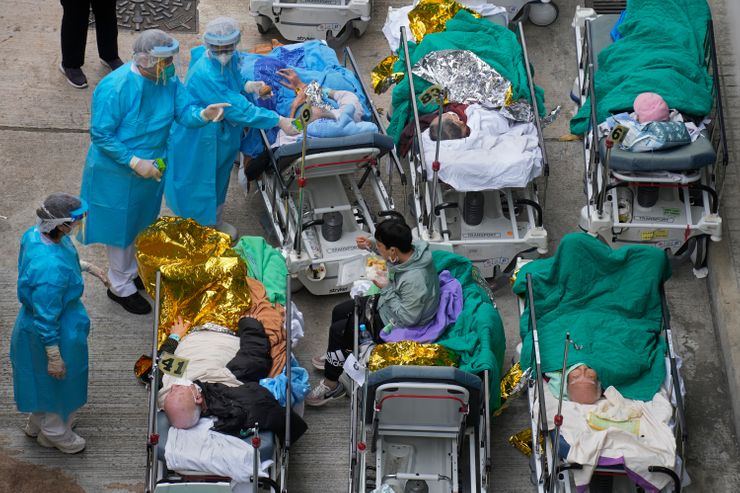
So while Singapore’s health care system is not in jeopardy of becoming overwhelmed, Hong Kong hospitals are at 90% capacity and some have had to treat patients outdoors for lack of room inside.
Hong Kong leader Carrie Lam shows no sign of retreating from the “zero-COVID" stance, saying Thursday that fighting the pandemic was her “paramount task” and the city would “not be distracted by other things.”
“We will impose any measures that we should,” she said. “The aim is to make sure Hong Kong people’s lives and health are protected and to uphold Hong Kong’s stability.”
To relieve some pressure on hospitals, officials now say some patients with mild symptoms will be able to leave hospitals after just seven days — half the current requirement — if they test negative and are not living with any high-risk individuals.
At the current rate of spread of infections new daily cases could rise to 28,000 by March, so it's unclear that will be enough.
On the other hand, relaxing the zero-COVID strategy would hinder travel between the city and the mainland, where authorities require three weeks of quarantine or more. Beijing will not reopen Hong Kong’s border with the mainland until the city reaches and maintains zero COVID-19 cases.
Chinese leader Xi Jinping said this week that Hong Kong’s “overriding task” was to get control of the situation. Some health experts from the mainland arrived Thursday to help with testing. Beijing also sent antibodies and other resources.
Customers at the Fung Shing Restaurant said they felt powerless.
“I feel so helpless for this restaurant under the pandemic,” said customer Mo Wan, a 78-year-old who has been a regular for the past decade. “I have established a deep friendship with the staff members.”
Up to 3,000 of Hong Kong's 17,000 restaurants could end up closing if current restrictions continue through March, said Michael Leung, chairman of the Association for Hong Kong Catering Services Management, which represents 800 restaurant owners.
Leung has temporarily shuttered his own restaurant, the Lucky Dragon Palace.
It's a sprawling establishment that would normally seat 1,000 before the pandemic. Leung hopes to hold on, paying the rent and saving on labor and utilities until he can reopen.
“The pandemic is very serious, there’s barely anyone on the street,” he said. “With fewer people going out, it means no business for restaurants. This fifth wave really impacts us terribly. It’s really an ice age for the catering business.”
_____
Rising reported from Bangkok. Associated Press journalist Janice Lo in Hong Kong contributed to this report.
More News

Want to bag a break but save some cash? Here's our pick of the best travel deals available this week - from savings on all-inclusive Egypt stays to affordable city breaks
The Daily Mail's travel desk brings you a selection of the best deals currently available - so you can bag a bargain break.

Illegal mining threatens French Guiana forests and indigenous communities
In French Guiana, the fight against illegal gold mining is rapidly being lost and creating an environmental and health disaster, according to the World Wildlife Fund. During an aerial survey in early August, park rangers counted 239 illegal sites within the protected area in record.

15 Products Self-Described Overpackers Swear By
Love you, but HOW do you not own a pack of compression bags yet...? View Entire Post ›

"In Spain, It Was Everywhere": 40 Things That Exist Outside The US That Prove America Is Embarrassingly Behind The Rest Of The World
"They put ours to shame." View Entire Post ›

Plan A Trip Around The World, And I'll Tell You Which American City You Should Visit
As Mr. Worldwide once said: "Brazil, Morocco, London to Ibiza. Straight to LA, New York, Vegas to Africa" View Entire Post ›

27 Products That’ll Make Holiday Travels So Much Smoother
Because there are one too many holiday movies that start with the main character missing a flight, and that does NOT need to be your journey this season. View Entire Post ›

The science of Cantonese soups and the gut health benefits – just don’t boil too long
In the first instalment of a four-part Health Matters series on food and health, Lisa Cam unpacks the enduring ritual of Cantonese soup, revealing what modern science says about family recipes, seasonal ingredients and the modern workarounds keeping this domestic staple on the table. In many Chinese households, soups are seen as a show of love from the cook – usually the matriarch of the family. Soup can be everyday food or a banquet course made with ingredients according to the season. The...

Has treatment for stuttering been off base? New guidelines go beyond speech to the brain
More than 80 million people worldwide stutter, yet misconceptions on it persist in the medical field, and access to appropriate care can be limited. New international medical guidelines aim to change that.

Canada is spending more than ever on health care. Are we getting our money's worth?
Canada is spending more on health care than ever. Whether Canadians are getting more care for their money is another question. A new report from the Canadian Institute for Health Information (CIHI) projects health-care spending will reach a record $433 billion in 2026, or $10,398 per person, an increase of 4.8 per cent over last year.

Why Some Flights Were Exempt From the Ground Stop
Dozens of international flights departed from the United States during Friday’s nationwide ground stop. Some planes also left for Hawaii from the West Coast.

Brooke Shields’ jeans? Met Gala’s ‘extraOrdinary’ show celebrates everyday fashion
And now, Take 2: the new Met Gala exhibition will celebrate everyday garments and materials such as jeans and puffer jackets, paper and plastic – and how fashion designers transform them. The new theme sounds about as far as can be imagined from the glittering, elaborate designs of John Galliano, the British designer who was originally the subject of the Met’s fashion exhibition next spring – before that idea was scuttled amid an outcry over his past antisemitic statements. The replacement show...

Le Plaza set to shake up Geneva’s cultural scene with new hotel concept and reimagined cinema
Following the opening of Brasserie Europe at Le Plaza in June, the cultural destination is now gearing up to open Cinéma-Hôtel Le Plaza on 04 December 2026, marking a major milestone for the project. This will then be followed by the opening of the reimagined historic Plaza Centre Cinéma on 22 April 2027, completing the transformation of this iconic architectural landmark.